In our family-run farm business, we value excellent taste, personal hospitality, and the highest customer satisfaction. We bring agricultural cultivation and artisanal processing to life as delicious product specialties with great passion and attention to detail. We consider ourselves responsible for honest and sustainable agriculture, love our craft, and always measure our success by the satisfaction of our customers, whom we take the time to consult.
The best quality and taste are our top priorities, as evidenced by numerous awards. In our specialty manufactory, we place the utmost importance on high-quality and fresh ingredients (if not grown ourselves, then as regional and fresh as possible). The main ingredients, such as strawberries, blueberries, table pumpkins, and pumpkin seeds, come from our own cultivation. This allows us to ensure that only varieties with the best aroma are planted. During harvest, we pay particular attention to the freshness, quality, and ripeness of the fruit. We process it by hand as gently and carefully as possible so that the full aroma of the fruit is preserved. Knowledge, experience, and a fine touch are, of course, essential to creating truly special products. The ideas for our specialties come from old family cookbooks, are our own creations, or suggestions from our customers – we find inspiration everywhere. We continuously improve and refine our recipes. Our attractive packaging makes them a culinary delight to behold as well.
Thanks to the high quality of our products and the mutual support of all family members, we are able to run our farm as our primary business, with a total cultivation area of 23 hectares. Innovation and creativity have always been part of the family tradition and have led to over 40 handmade product specialties made from strawberries, table pumpkins, and pumpkin seeds in recent years.
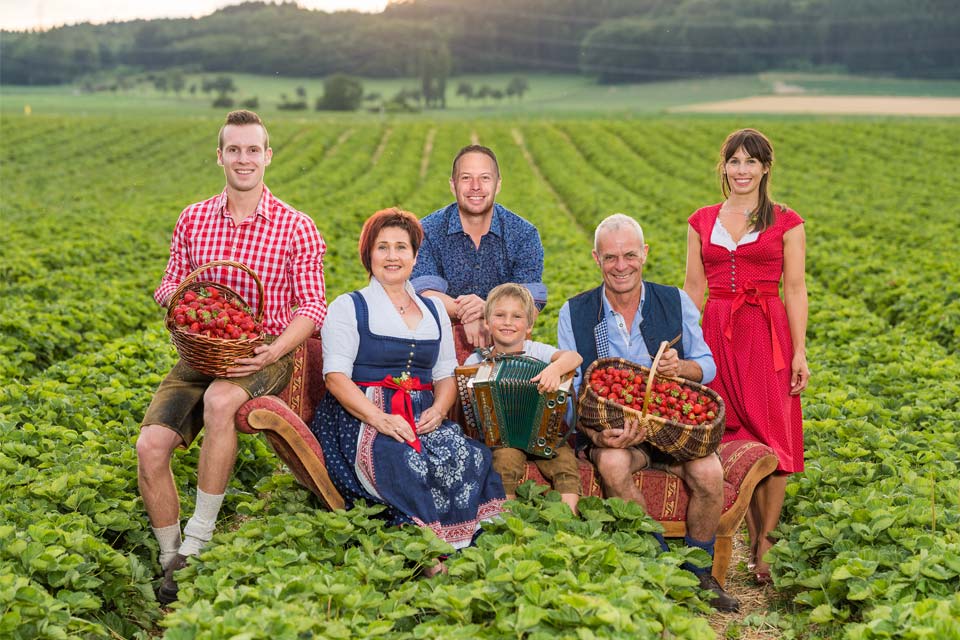
Maria Wurzer is the creative force in the farm and is in charge of processing the fruit. She is a trained seminar farmer and is known for her excellent cakes, pastries, and sweet dishes. She has published two cookbooks ("Pumpkin: 120 Brilliant Recipe Ideas" and "Wieselburg Baking Specialties") and has contributed to numerous others.
Karin Wurzer attended the Francisco Josephinum in Wieselburg, then completed the Academy for Medical-Technical Laboratory Services at the LKH Steyr, and is employed at the eye clinic of the AKH Linz. In her free time, she enjoys helping out on the farm.
Markus Wurzer studied "Product Marketing & Project Management" with a focus on food at the Fachhochschule Wieselburg. He is responsible for marketing, sales, and product development. In addition, he was involved in the founding of the Wieselburger Schmankerlladen where our specialties are also available.
Dominik Wurzer attended the Francisco Josephinum (focusing on agriculture), is jointly responsible for the agricultural activities, and works diligently in production.
Leon Wurzer is Karin's youngest son and the sunshine of the family. He started playing the Styrian accordion at the age of 4, now also plays the tuba, and loves entertaining our guests with musical performances.
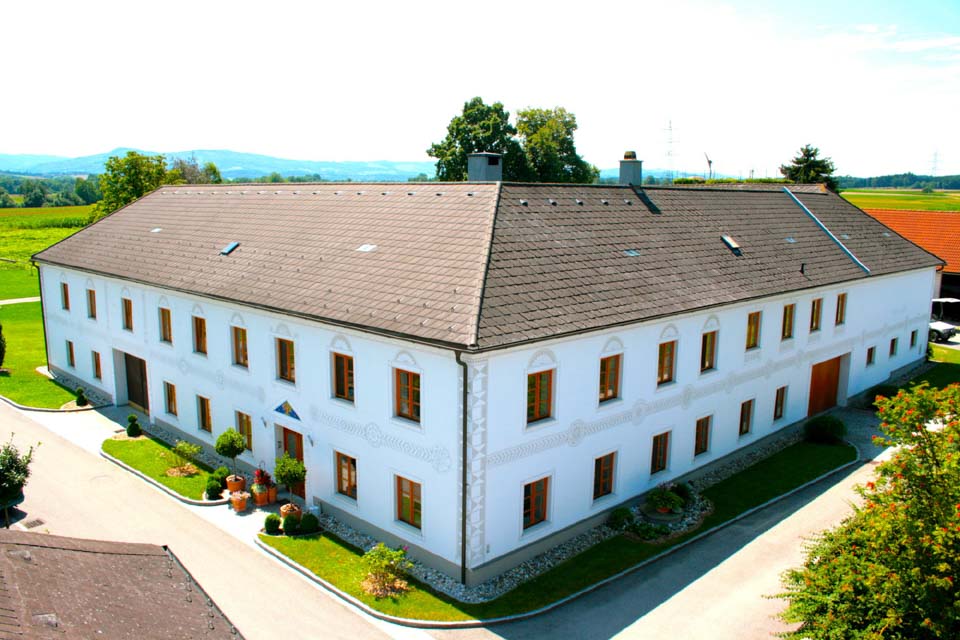
The History of Our Farm
1250-1686
The houses subject to the lordship of Wieselburg are among the oldest in Bodensdorf, dating back to 1324. For this house, the owners can be traced back almost to the beginning using the parish registers.
1686-1721
The first owner in 1686 was Phillipp Räbel. The previous owners probably lost their lives during the Turkish invasion. Phillipp Räbel sen. was born in Bodensdorf in 1649 (today House No. 2); his parents were Räbl Veit (Vitus) and Susanna. Philipp, originally from Bodensdorf, took a detour through Krügling, and after 1683 he and his family returned to Bodensdorf. He married in Griegling before 1675, as he and his wife Rosina had a son there in April 1675. A daughter followed in December 1676. In 1680 Phillipp Räbel became a widower and married Catharina Guettlederer from Berging on September 7, 1680. Their first child was born in Krigling in 1682. After the Turkish invasion in the summer of 1683, the family is documented in Bodensdorf, as their daughter Regina was born there on July 24, 1686. With one exception, the couple Georg and Magdalena Voringer in Plackha were the godparents of all the children in 1689. Catharina Räbl died in Bodensdorf in 1709 at the age of 62, and Phillipp Räbl in 1721 at the age of 80.
1711-1745
Regina Räbl, born in 1686, married Mathias Pränckhel from Harbachmühl, St. Leonharder Parish, on September 13, 1711. Two of her children died at birth, while the third, born in 1720, survived. After his wife's death, Mathias Pränckhel married Catharina Kürchweger from Staindlhof in Ruprechtshofener Parish. They had six children, three of whom died in infancy. When the youngest child turned exactly four years old, the father died in 1745 at the age of 62. According to the land register, the property was a full tenancy in 1718 with 18 day-works, of which 2 day-works were overlain and castle-right lands.
1745-1768
Three months later, on June 2, 1745, the widow Catharina Pränkhl married Joan Pirwipfel from Wolfpassing, who was about 15 years younger than the bride. The 45-year-old owned a large farm, while the groom, around thirty, was probably a hardworking farmer's son. Both probably made a good choice. The marriage lasted 23 years until tragic events multiplied in 1768. On March 15, 1768, the farmer Catharina died at the age of 67.
1768-1825
Two months later, on May 15, 1768, the 53-year-old widower Joannes Pirwipfel married Anna Maria Dachßberger from Ezetsstetten, who was just over 20 years old. Joannes died less than two months later. He made room for a 26-year-old farmer. Five weeks later, on August 14, 1768, the young widow Anna Maria Pirwipfel married Jacob Hofmarcher from Arätßfeld (Euratsfelden). However, according to the marriage register, his name was not Jacob, but Görg (Georg). The schoolmaster, who served as the parish register clerk, was inaccurate. He had originally written "Fraz," but crossed out this name, as well as the note about the groom's origin from Petzenkirchen. Then he wrote "Görg," as his father was named, and corrected it to Arätßfeld. For all twelve children born by 1789, the parents were always listed as Jacob and Anna Maria, née Daxberger (Dachsberger). Four of her children died. Anna Maria Hofmarcher died of typhus fever in 1812 at the age of 68, and Jakob Hofmarcher died in 1825 at the age of 83.
1808-1836
In 1808, the son Joseph Hofmarcher, born in 1787, took over the property. Both parents were still alive, and only after his mother's death did he marry 20-year-old Anna Maria Einsiedler from Winden, Neumarkt Parish, on October 6, 1812. Of the eleven children, six did not survive infancy. They died of measles, purulent pneumonia, malignant scarlet fever, and pertussis. At the ages of 13 and 17, the children Ignaz and Cäcilia died of consumption and pulmonary tuberculosis. Only three of their descendants are found in the marriage registers later. The mother died of pulmonary tuberculosis three months after the last birth, on September 2, 1836.
1837-1855
Joseph Hofmarcher, a 50-year-old widower, remarried Theresia, widowed Waxenecker, née Bramer, on November 21, 1837. She was 49 years old; her husband Michael Waxenecker had been a farmer in Kalcha, Ruprechtshofen Parish. When her second husband, Joseph Hofmarcher, died of dropsy on May 7, 1850, at the age of 62, after 16 1/2 years of marriage, the widow transferred the property to her 19-year-old son Alois from her first marriage. Theresia Hofmarcher died of exhaustion on December 5, 1855, at the age of 74.
1850-1875
Alois Waxenegger married his young farmer's wife from Wallingbach (Wallenbach) and married 22-year-old Josefa Steinlesberger on August 19, 1850. They had nine children. One child died of typhus at the age of 9, and three others died of lung diseases: one at the age of 2 from bronchitis, another at the age of 1 from pulmonary edema, and the third in 1882 at the age of 26 from pulmonary tuberculosis. The father Alois died of the same disease in 1871 at the age of 43, and the mother Josefa in 1876 at the age of 48. Death claimed its victims one after another: in 1874, the tenant Leopold Erber died of dropsy at the age of 67, and in 1875 Josefa's mother, Magdalena Steinlesberger, died of pneumonia at the age of 82. After her husband's death, Josefa Wachsenegger owned the farm alone; after her death, her eldest son, Carl Boromäus Waxenegger, born in 1851, inherited it. His youngest brother was only 10 years old.
1876-1902
Carl Waxenegger, a farmer and landowner, married Theresia Bodenberger on September 12, 1876. In the land register of Scheibbs, Theresia Wachsenegger was entered as the sole owner by adverse possession on July 3, 1902. At the age of 49, on May 23, 1902, she married Leopold Wurzer Brunninger, who became the joint owner.
1902 to the present
When Theresia Wurzer died in 1911, Leopold Wurzer took over her half. He married Barbara Ederer. Four children came from this second marriage: Anna (married König); Franz fell in 1941 in Crimea; Hans married in Marbach, and he is the discoverer of the Roman casserole; Leopold took over the farm in 1950; his wife Leopoldine, née Fischhuber, was entered as a joint owner in 1951. The couple had two children: Leopold and Anneliese. In 1983, the son Leopold Wurzer, born in 1961, and his wife Maria, née Ehribauer, became joint owners of Loipersdorf bei Mank, each owning half. The names of their three children are Karin, Markus, and Dominik.
0 comments